Standing brief, as of 8 September 2026.
Lead Signal
The National Payment Switch, built by PayLogic under the World Bank-backed PADSF project, has gone live, connecting commercial banks, microfinance institutions and mobile money operators onto a single interoperable rail for the first time. This coincides with the Banque Centrale des Comores' formal commencement of Pan-African Payment and Settlement System integration, which is designed to let Comorian payments reach other African markets directly in Comorian francs. Together the two milestones mark 2025 as an infrastructure inflection point for a market that has historically been thin, cash-dominant and bank-mediated.
Running alongside this genuine infrastructure build-out is the continued presence of the Mwali International Services Authority and the Anjouan Offshore Finance Authority, offshore paper-licensing operations that the Banque Centrale des Comores, the IMF, the World Bank and the FATF have all confirmed carry no legal standing and exist solely to sell paper licenses. Moheli itself has no distinct sub-national licensing regime; all banking, payment and e-money licensing on the island runs through the Union-level BCC, and MISA cannot issue warnings, impose penalties, suspend licences or initiate court proceedings.
Other Developments
The Banque Centrale des Comores has also exercised direct conduct oversight by publicly declaring that the 'Huri Money' e-money service launched by Comores Telecom is not approved by the Central Bank of Comoros. On digital money, the BCC operates no stablecoin or virtual-asset authorisation regime, and Union-recognised digital money remains limited to the BCC's e-money and electronic-money-institution framework; a separate MISA-hosted 'virtual currency' registration track carries no Union legal effect. Card-scheme infrastructure remains minimal nationwide, with only 37 ATMs, 28 POS devices and 34,000 cards in circulation and no cross-network interoperability, a footprint mediated almost entirely through bank membership of Visa. The consolidated banking-system balance sheet reached KMF 262.3 billion at end-December 2025, up from KMF 229.4 billion a year earlier, with gross customer loans up 8% year-on-year to KMF 145.8 billion and deposits up 13.5% to roughly KMF 221 billion. Merchant acquiring capacity is similarly thin and bank-concentrated, though the new switch is expected to materially improve merchant settlement speed. Underpinning much of this, Comoros formally adopted a National Financial Inclusion Strategy 2025-2030 on 8 October 2025, which underpins phased rollout of KomorPay, the Komor Switch interbank platform, a National Payment Hub and the Mali Ya Wakazi agent network. Consumer protection continues to run through the same channel, with the BCC's unauthorised-provider warnings serving as the primary safeguard in the absence of a codified fraud-reimbursement or ombudsman regime. Correspondent-banking and settlement access for the Union runs primarily through the Banque de France-linked monetary-cooperation architecture underpinning the Comorian franc's euro peg, now supplemented by the new PAPSS route.
Cross-Monitor Connections
Comoros' AML/CFT regime remains under enhanced follow-up after its May 2024 FATF/GIABA mutual evaluation found the Union largely compliant on only four Recommendations and non-compliant on twenty-nine, a gap that the World Payments Monitor routes to the Financial Integrity Monitor rather than analysing directly. The same disavowed MISA/AOFA offshore-licensing scheme is separately flagged to the Financial Integrity Monitor as a fraud and potential money-laundering vehicle risk that sits outside WPM's payments-market-access remit.
Outlook
Whether the PAPSS corridor translates into practical settlement access will depend on how quickly Comorian commercial banks actually onboard, since the BCC Governor's appeal for banks to join the rail was framed as a precondition for access rather than a completed step. The financial-inclusion strategy's remaining components, including KomorPay and the National Payment Hub, are still in phased rollout. Meanwhile the offshore-licensing shopfront has not been shut down despite years of disavowal, so both threads warrant continued monitoring into the next cycle. Enhanced follow-up under the FATF/GIABA process, including the absence of a designated mutual-legal-assistance authority and limited bilateral judicial-cooperation agreements, is likely to remain the primary lens through which cross-border AML/CFT cooperation gaps are tracked for Comoros in coming cycles. Several structural gaps persist in the underlying record for this jurisdiction: no dedicated interchange or surcharging regime, no incident-reporting framework for critical payments infrastructure, and no formal litigation register for payments activity have yet been identified, and each remains an open item for future research passes. That bank-versus-non-bank line, evident in the gap between the BCC's Union licence covering both banks and payment/e-money institutions and the Huri Money warning aimed specifically at a non-bank e-money offering, is likely to remain the organising distinction for future licensing and conduct findings in this jurisdiction. Taken together, the cycle establishes a first full baseline for Moheli and Comoros across all fourteen World Payments Monitor modules, against which subsequent cycles will be measured. The overriding judgment for this cycle is that centralisation and modernisation are advancing in tandem: a fully Union-centralised licensing regime is now paired with a fast-moving 2025 infrastructure build-out, even as a fraudulent offshore licensing shopfront continues to trade on the Moheli name.
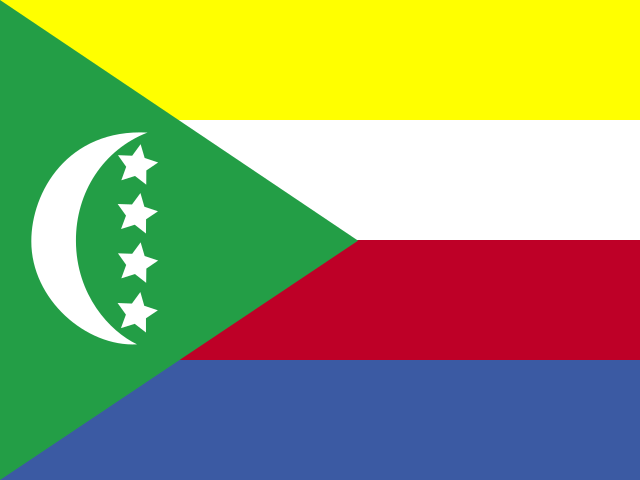 KM-M
KM-M