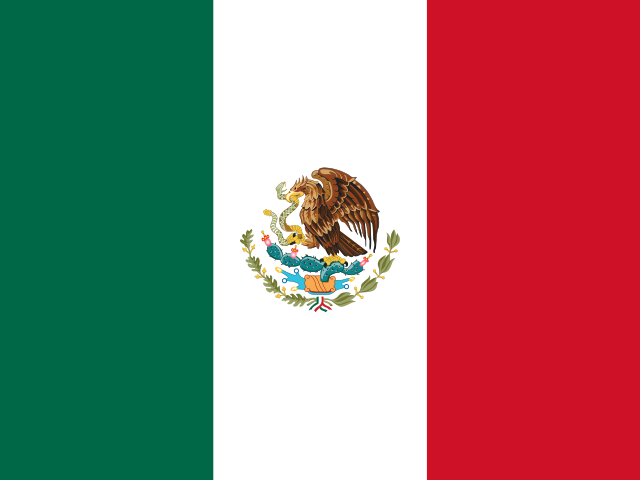
Mexico (MX)
Lead Signal
Mexico's card-payments economics are entering their most consequential reordering in years. On 27/28 October 2025 CNBV and Banxico released draft General Provisions Applicable to Payment Networks for public consultation, proposing interchange caps of roughly 0.6% on credit from a weighted average near 1.35% and 0.3% on debit from around 0.45%, alongside mandatory network interoperability, ISO operating standards, and expanded supervisory powers, with future tightening linked to adoption benchmarks reviewed twice annually. The reform directly targets the structure it would reshape: aggregators such as Mercado Pago — which exceeds 1m active terminals, matching all traditional banks' combined estate of roughly 1.4m — cluster merchant discount rates in the mid-3% range (Mercado Pago at 3.49% plus VAT, Sr. Pago at 3.5% plus VAT), with interchange the largest single MDR component. Commercial banks still clear 91.3% of card value, and COFECE has flagged a highly concentrated two-player POS clearing layer. A halving of interchange paired with mandated interoperability is therefore the single most consequential pending payments reform for Mexican acquirers, issuers and aggregators alike.
The reform did not arrive in isolation. On 27 April 2026 CNBV and Banxico published a Resolution adding Provision 10 Bis to the payment-networks rules, temporarily eliminating the interchange fee on card payments at gas stations under a tripartite agreement coordinated by SHCP; the Resolution entered into force on 28 April 2026, the day after DOF publication, with a stated validity period running 1 May 2026 to 31 October 2026. This first concrete, sector-specific zero-interchange intervention reads as an early targeted precursor to the wider cap reform, and establishes that targeted interchange suppression is now a live instrument in the regulators' hands.
Outlook
The defining tension across the Mexican operating environment is between an aggressive domestic reform agenda and a stalled regulatory build-out. The payment-networks interchange reform sits in consultation through 2026, contested by incumbents including BBVA and Banamex, with the gas-station Resolution already operative as a precursor. Against this, open finance remains structurally stalled: the Fintech Law Article 76 transactional-data secondary regulation is years overdue and unpublished, the regulatory sandbox has authorised zero entities, and the gap is now under amparo litigation filed in December 2025 naming CNBV, Banxico and SHCP. Direct IFPE access to SPEI continues to give non-bank PSPs a structural settlement-access advantage relative to jurisdictions gating RTGS to banks — a feature reinforcing the aggregator and neobank surge despite a highly concentrated IFPE asset base. Expect interchange, correspondent-banking access, and open-finance publication timing to remain the three axes of concurrent regulatory and access pressure into the coming cycle.
Other Developments
The second defining shock for the Mexican operating environment is external and concerns settlement access rather than pricing. Following FinCEN's June 2025 Section 311 orders identifying CIBanco, Intercam and Vector as of primary money-laundering concern — the first use of authority under the Fentanyl Sanctions Act and FEND Off Fentanyl Act — covered institutions are prohibited from sending or receiving funds, including virtual currency, to or from the three named entities, effectively excluding them from the US financial system. CIBanco filed a DC District Court suit on 17 August 2025 to suspend the order, later voluntarily dismissed; CNBV assumed temporary management of CIBanco and Intercam, and SHCP moved their trust businesses to development banks. CNBV also imposed more than MXN 185m in 2025 penalties across the three institutions. The payments-access consequence — acute correspondent-banking de-risking pressure on Mexican exposure — is what WPM carries; the underlying illicit-finance analysis belongs to the Financial Integrity Monitor.
The US-to-Mexico remittance corridor, the world's largest bilateral flow, is contracting under its own set of pressures. Mexico received approximately US$61.8bn in remittances in 2025, down roughly 4.6% from the 2024 record of US$64.7bn — the first annual decline since 2013. A US federal 1% remittance excise enacted in July 2025 applies from 1 January 2026, but only to cash, money-order and cashier-check-funded transfers, with bank, debit and credit-funded transfers exempt — a scope that materially channels flows toward exempt account and card-funded rails. More than 99% of these flows settle via SPEI once funds reach the domestic system.
On the access and inclusion side, in June 2026 Banxico, with the ABM, announced a simplified deposit-account tier (Cuenta Nivel 3 Bis) with higher deposit limits of up to 3,000 UDIS, targeting an estimated 4 million small merchants historically locked out of digital payments. The fintech ecosystem itself is maturing toward late-stage capital: in late June/July 2025 Mexico City digital bank Klar raised US$190m in a Series C led by General Atlantic at a valuation exceeding US$800m, and Ant International acquired R2, a Mexico-based embedded-lending fintech serving platforms such as Rappi and InDrive.
Cross-Monitor Connections
The FinCEN Section 311 designations, the July-2025 AML-law VASP amendment introducing travel-rule and 210 UMA reporting obligations, and related Sinaloa-linked casino actions are Sentinel-fed AML/CFT surface; original illicit-finance analysis is routed to the Financial Integrity Monitor, with WPM retaining only the correspondent-banking-access (W12) and litigation (W7) dimensions. Separately, peso-stablecoin activity (MXNB, MMXN) concentrated on the US-MX remittance corridor carries potential illicit-finance and sanctions-evasion significance; WPM holds only the trust-as-payment-instrument view and routes illicit-finance use to FIM.
Domains
14 regulatory modules · click to expand the full sub-briefLicensing, Authorisation & Market Access
ConfirmedMexico's market-access gateway is defined by the 2018 Fintech Law (Ley Fintech), which establishes two ITF licence types — the IFPE (Electronic Payment Funds Institution, the e-money/wallet licence) and the IFC (Crowdfunding Institution).
Conduct, Safeguarding & Promotions
Confirmed(Duplicate module guard — see primary W1b entry above; this slot retained for enum completeness.)
Stablecoins & Digital Money
HighMexico has no dedicated stablecoin framework, and virtual assets are not legal tender under Article 30 of the Fintech Law and Banxico Circular 4/2019.
Operational Resilience & Critical Infra
HighMexico has no standalone operational-resilience regulation and no DORA equivalent.
Scheme & Network Compliance
ConfirmedW4 carries the most material live regulatory development in the Mexican payments space.
Payment Corridor Dynamics
ConfirmedMexico's dominant domestic rail is SPEI, Banxico's 24/7 real-time interbank system launched in 2004, complemented by SPID for USD and the consumer overlays CoDi (QR/NFC, 2019) and DiMo (phone-alias, 2023).
Full per-domain detail — all 14 modules
W1aConfirmedLicensing, Authorisation & Market Access
see this theme across all jurisdictions →5 claimsMexico operates a dedicated 2018 Fintech Law (Ley para Regular las Instituciones de Tecnología Financiera) establishing two ITF licence types: Electronic Payment Funds Institutions (IFPE, e-money/wallet) and Crowdfunding Institutions (IFC). Licences are granted by CNBV with the prior favourable opinion of an Inter-institutional Committee (CNBV, SHCP, Banxico). Non-bank route runs via the IFPE; bank-PSP route via the Banking Law (Ley de Instituciones de Crédito). Foreign-currency, cross-border and virtual-asset operations require additional Banxico approvals. As of late 2025 roughly 60-88 IFPEs are authorised; the segment is highly concentrated.
No periodic updates yet · baseline brief is current.
Read the full sub-brief
Licensing, Authorisation & Market Access
Mexico's market-access gateway is defined by the 2018 Fintech Law (Ley Fintech), which establishes two ITF licence types — the IFPE (Electronic Payment Funds Institution, the e-money/wallet licence) and the IFC (Crowdfunding Institution). Authorisations are granted by CNBV with the prior favourable opinion of an inter-institutional committee comprising CNBV, SHCP and Banxico. This frames the central bank-PSP vs non-bank-PI/EMI distinction at the point of entry: the non-bank route runs via the IFPE under the Fintech Law, while the bank-PSP route runs via the Banking Law. The IFPE-versus-bank-versus-SOFOM/SOFIPO laddering shapes entry strategy for operators including Nubank, Revolut and MercadoPago.
On the state of the segment, per Banxico late-2025 reporting, IFPEs are the largest ITF segment with 62 of 134 applications authorised, and activity is highly concentrated, with 82.4% of reported IFPE assets held by the eight largest IFPEs. This concentration signals limited contestability despite headline authorisation counts. A material caveat applies to the numbers: the total-authorised-institutions figure of 89 (62 IFPEs plus 27 IFCs) should not be conflated with the IFPE-only count of 62, and counts here are carried as IFPE-segment figures only. The precision of these authorisation counts is under-indexed, resting on Tier-3 journalism rather than the primary CNBV/SIPRES register.
Live market-access traction is evident in cross-border entry: in August 2025 Chilean fintech Fintoc received SHCP authorisation, published in the DOF, to operate as an IFPE, to be regulated by CNBV and Banxico. The DOF/SHCP authorisation fact stands, though the '88th institution' ordinal framing carried in source reporting is ambiguous against the late-2025 count of 62 authorised IFPEs and should not be read as a precise register position.
Outlook
The IFPE/IFC regime is mature and established as the standing market-access spine for Mexico. The principal forward watch-items are the signalled 'Fintech Law 2.0' redesign — on which CNBV has indicated readiness to contribute, covering digital assets, open finance and competitiveness, though no draft yet exists — and any primary CNBV/SIPRES confirmation that would resolve the IFPE-count ambiguity. Cross-border IFPE entry of the Fintoc type is expected to continue as the live evidence of non-bank market-access contestability.
Mexico operates a dedicated 2018 Fintech Law (Ley para Regular las Instituciones de Tecnología Financiera) establishing two ITF licence types: Electronic Payment Funds Institutions (IFPE, e-money/wallet) and Crowdfunding Institutions (IFC). Licences are granted by CNBV with the prior favourable opinion of an Inter-institutional Committee (CNBV, SHCP, Banxico). Non-bank route runs via the IFPE; bank-PSP route via the Banking Law (Ley de Instituciones de Crédito). Foreign-currency, cross-border and virtual-asset operations require additional Banxico approvals. As of late 2025 roughly 60-88 IFPEs are authorised; the segment is highly concentrated.
Evidence — 5 structured claims
Key facts
- Content Tier
- SB
- Sentinel Feed
- False
Event Findings
IFPE safeguarding/conduct rests on the Fintech Law and secondary regulations (notably Banxico Circular 12/2018 and the 2021 IFPE Provisions). IFPEs may not pay interest on client balances (Art. 29) and must segregate/manage client electronic funds under Banxico's operative rules; the General Director carries personal liability for material vendor contracting (Art. 44 CUIFPEs). Conduct, transparency and financial-promotion oversight is shared between CNBV (prudential/AML), Banxico (fees/operative rules) and CONDUSEF (consumer transparency, standard-form contracts, abusive-clause control). FTIs must avoid disseminating false or misleading information and disclose transaction risks.
No periodic updates yet · baseline brief is current.
Read the full sub-brief
Conduct, Safeguarding & Promotions
(Duplicate module guard — see primary W1b entry above; this slot retained for enum completeness.)
Outlook
See primary W1b Outlook.
IFPE safeguarding/conduct rests on the Fintech Law and secondary regulations (notably Banxico Circular 12/2018 and the 2021 IFPE Provisions). IFPEs may not pay interest on client balances (Art. 29) and must segregate/manage client electronic funds under Banxico's operative rules; the General Director carries personal liability for material vendor contracting (Art. 44 CUIFPEs). Conduct, transparency and financial-promotion oversight is shared between CNBV (prudential/AML), Banxico (fees/operative rules) and CONDUSEF (consumer transparency, standard-form contracts, abusive-clause control). FTIs must avoid disseminating false or misleading information and disclose transaction risks.
Evidence — 4 structured claims
Key facts
- Content Tier
- SB
- Sentinel Feed
- False
Event Findings
Mexico has no dedicated stablecoin framework; e-money is governed by the IFPE regime under the Fintech Law. Virtual assets are narrowly defined (Fintech Law Art. 30 + Banxico Circular 4/2019) and are NOT legal tender. A 2021 joint Banxico/SHCP/CNBV press release deems stablecoin issuance against fiat a reserved banking/deposit-taking activity restricted to regulated institutions (FTIs/banks), and FTIs/banks may only use virtual assets for internal operations with Banxico authorisation. A retail CBDC (digital peso) was announced for ~2024-2025 but remains delayed in early research; Banxico has publicly flagged stablecoin financial-stability risks (Dec 2025). MXNB and MMXN are peso stablecoins circulating off-rail.
No periodic updates yet · baseline brief is current.
Read the full sub-brief
Stablecoins & Digital Money
Mexico has no dedicated stablecoin framework, and virtual assets are not legal tender under Article 30 of the Fintech Law and Banxico Circular 4/2019. The defining regulatory posture comes from a 28 June 2021 joint Banxico/SHCP/CNBV statement holding that issuing fiat-backed stablecoin collection rights is the reserved activity of soliciting deposits or funds, restricted to regulated institutions, with FTIs and banks needing Banxico authorisation to use virtual assets internally. The effect is that stablecoin issuance is treated as reserved banking activity, closing the unlicensed-issuer route and channelling peso-stablecoin activity (MXNB, MMXN) into the remittance corridor off-rail. WPM holds only the trust-as-payment-instrument framing here; any illicit-finance use is routed to FIM.
The central bank's posture has hardened further: in December 2025 Banxico warned that stablecoins present significant financial-stability risks — citing reliance on short-term US Treasuries, issuer concentration and past depegging — and signalled an intention to keep cautious distance between the traditional financial system and virtual assets, while acknowledging settlement and remittance benefits.
On central-bank digital money, no CBDC currently exists in Mexico. Banxico announced plans for a retail digital peso around 2025, but the initiative remains in an early research and evaluation stage and has faced delays, with no committed pilot or issuance timeline as of early 2026; Banxico participates in BIS Project Agorá. The announcement was of plans rather than a confirmed launch window.
Outlook
The stablecoin and digital-money surface is stable with a cautious-to-hardening regulatory tilt. With issuance treated as reserved banking activity and no dedicated statute in prospect, peso-stablecoin payment activity should continue to concentrate on the remittance corridor rather than integrate into the mainstream system. The stalled digital-peso programme means no near-term central-bank retail rail competition; SPEI, CoDi and DiMo remain the inclusion vehicles. Any digital-assets chapter within a future Fintech Law 2.0 is the principal forward variable.
Mexico has no dedicated stablecoin framework; e-money is governed by the IFPE regime under the Fintech Law. Virtual assets are narrowly defined (Fintech Law Art. 30 + Banxico Circular 4/2019) and are NOT legal tender. A 2021 joint Banxico/SHCP/CNBV press release deems stablecoin issuance against fiat a reserved banking/deposit-taking activity restricted to regulated institutions (FTIs/banks), and FTIs/banks may only use virtual assets for internal operations with Banxico authorisation. A retail CBDC (digital peso) was announced for ~2024-2025 but remains delayed in early research; Banxico has publicly flagged stablecoin financial-stability risks (Dec 2025). MXNB and MMXN are peso stablecoins circulating off-rail.
Evidence — 5 structured claims
Key facts
- Content Tier
- SB
- Sentinel Feed
- False
Event Findings
Mexico has no standalone operational-resilience regulation (no DORA equivalent). Resilience, cybersecurity and incident-reporting obligations are assembled from CNBV's Circular Única de Bancos (CUB) for banks, CNBV cybersecurity/information-security guidelines, the Fintech Law/CUITF for ITFs, the Payment Systems Law and Banxico Circular 8/2019 for SPEI participants. Banks must report significant operational/cybersecurity incidents to CNBV promptly; cloud/IT outsourcing requires CNBV authorisation (CUB Arts. 318-328). PCI DSS is mandatory for card processing. 2026 supervisory practice emphasises evidence-grade audit trails over written policy.
No periodic updates yet · baseline brief is current.
Read the full sub-brief
Operational Resilience & Critical Infrastructure
Mexico has no standalone operational-resilience regulation and no DORA equivalent. Resilience, cybersecurity and incident-reporting obligations are assembled from a patchwork spanning CNBV's Circular Única de Bancos, CNBV cybersecurity guidelines, the Fintech Law/CUITF, the Payment Systems Law and Banxico Circular 8/2019 for SPEI participants. Banks must promptly report significant operational and cybersecurity incidents to CNBV, and cloud or IT outsourcing requires CNBV authorisation under CUB Articles 318-328. For operators across both the bank-PSP and non-bank tiers, the absence of a single resilience instrument means a fragmented compliance surface, and the cloud-outsourcing pre-authorisation requirement (CUB 318-328) is a material onboarding constraint.
Outlook
This is an under-indexed surface: the composite resilience picture relies on aggregator and law-firm secondary sources rather than primary CNBV/Banxico instrument text, and the emerging-market operational-resilience domain is under-evidenced at primary level. No DORA-equivalent consolidation is signalled. The forward watch is whether any future regulatory redesign moves toward a consolidated resilience instrument; absent that, the patchwork persists and the cloud pre-authorisation gate remains the binding operational constraint.
Mexico has no standalone operational-resilience regulation (no DORA equivalent). Resilience, cybersecurity and incident-reporting obligations are assembled from CNBV's Circular Única de Bancos (CUB) for banks, CNBV cybersecurity/information-security guidelines, the Fintech Law/CUITF for ITFs, the Payment Systems Law and Banxico Circular 8/2019 for SPEI participants. Banks must report significant operational/cybersecurity incidents to CNBV promptly; cloud/IT outsourcing requires CNBV authorisation (CUB Arts. 318-328). PCI DSS is mandatory for card processing. 2026 supervisory practice emphasises evidence-grade audit trails over written policy.
Evidence — 4 structured claims
Key facts
- Content Tier
- SB
- Sentinel Feed
- False
Event Findings
Card networks are governed by the General Provisions Applicable to Payment Networks (Disposiciones aplicables a las redes de medios de disposición), jointly administered by CNBV and Banxico under the Law for Transparency and Ordering of Financial Services (LTOSF). Banxico regulates interchange/fees and clearing houses; payment processors must operate through authorised infrastructures (SPEI, SPID, Card Networks). A major October 2025 draft reform (Press Release 023) opened a public consultation proposing interchange caps (0.3% debit / 0.6% credit, down from ~1.15%/1.91%), mandatory interoperability and expanded CNBV/Banxico supervisory powers. PCI DSS is mandatory for card processing.
No periodic updates yet · baseline brief is current.
Read the full sub-brief
Scheme & Network Compliance
W4 carries the most material live regulatory development in the Mexican payments space. On 27/28 October 2025 CNBV and Banxico released draft General Provisions Applicable to Payment Networks for public consultation, proposing interchange caps of roughly 0.6% on credit (from a weighted average near 1.35%) and 0.3% on debit (from around 0.45%), mandatory network interoperability, ISO operating standards, and expanded supervisory powers, with future tightening linked to adoption benchmarks reviewed twice annually. The reform spans both the bank-PSP and non-bank tiers: affected entities include issuers and incumbents such as BBVA and Banamex, and aggregator/acquirers such as Mercado Pago and Clip. An interchange cap roughly halving credit and debit IC, paired with mandated interoperability, is the single most consequential pending payments reform for Mexican acquirers, issuers and aggregators.
Ahead of the wider reform, a concrete interim intervention has already landed. On 27 April 2026 CNBV and Banxico published a Resolution adding Provision 10 Bis to the payment-networks rules, temporarily eliminating the interchange fee on card payments at gas stations under a tripartite agreement coordinated by SHCP. The Resolution entered into force on 28 April 2026, the day after DOF publication, with a stated validity period of 1 May 2026 to 31 October 2026 — an effective-date distinction (28 April in-force vs 1 May validity start) carried with caveat pending primary DOF confirmation. This is the first concrete interchange intervention ahead of the wider cap reform, and the sector-specific (fuel) zero-IC sets a precedent for targeted IC suppression.
Outlook
The Scheme Rule Changes trajectory is escalating. The payment-networks reform sits in consultation through 2026 (uncertainty band: year) and is contested by incumbents, with future tightening explicitly linked to adoption benchmarks reviewed twice annually. The gas-station Resolution operates through 31 October 2026 as a precursor. The central forward question is the final calibration of the interchange caps and the interoperability mandate, and whether the targeted-suppression model demonstrated at gas stations is extended to other sectors before the general reform is finalised.
Card networks are governed by the General Provisions Applicable to Payment Networks (Disposiciones aplicables a las redes de medios de disposición), jointly administered by CNBV and Banxico under the Law for Transparency and Ordering of Financial Services (LTOSF). Banxico regulates interchange/fees and clearing houses; payment processors must operate through authorised infrastructures (SPEI, SPID, Card Networks). A major October 2025 draft reform (Press Release 023) opened a public consultation proposing interchange caps (0.3% debit / 0.6% credit, down from ~1.15%/1.91%), mandatory interoperability and expanded CNBV/Banxico supervisory powers. PCI DSS is mandatory for card processing.
Evidence — 4 structured claims
Key facts
- Content Tier
- SB
- Sentinel Feed
- False
Event Findings
Mexico's dominant domestic rail is SPEI (Banxico's 24/7 real-time interbank system, launched 2004), complemented by SPID (USD interbank) and the consumer overlays CoDi (QR/NFC, 2019) and DiMo (phone-number aliasing, 2023). The defining external corridor is US-to-Mexico remittances—the world's largest bilateral corridor (~US$61.8bn in 2025, down ~4.6% from 2024's record), with >99% settled via SPEI and a new US 1% remittance excise (effective 1 Jan 2026) shaping flows. Cross-border providers are supervised by CNBV (KYC/AML) with Banxico managing infrastructure.
No periodic updates yet · baseline brief is current.
Read the full sub-brief
Payment Corridor Dynamics
Mexico's dominant domestic rail is SPEI, Banxico's 24/7 real-time interbank system launched in 2004, complemented by SPID for USD and the consumer overlays CoDi (QR/NFC, 2019) and DiMo (phone-alias, 2023). SPEI settles funds between bank deposit accounts almost instantly and is the central settlement rail underpinning both domestic A2A and remittance delivery; direct IFPE access widens non-bank participation in it.
The corridor story is defined by the US-MX flow, the world's largest bilateral remittance corridor. Mexico received approximately US$61.8bn in remittances in 2025 per Banxico, down roughly 4.6% from the 2024 record of US$64.7bn — the first annual decline since 2013 — with more than 99% settled via SPEI once funds reach the domestic system. A US federal 1% remittance excise, enacted in July 2025, applies from 1 January 2026 to cash, money-order and cashier-check-funded transfers only, with bank, debit and credit-funded transfers exempt. The cash-only scope materially channels flows toward exempt account and card-funded rails. These quantitative anchors rest on Tier-3/Tier-4 commercial sources rather than Banxico primary statistics and are carried with appropriate confidence caveats; the excise effective-date and scope carry challenger caveats pending primary IRS confirmation.
Outlook
The corridor trajectory is contracting. With the world's largest bilateral flow recording its first decline since 2013 and a new US excise reshaping its economics, the key forward dynamic is corridor substitution toward exempt account/card-funded rails and the durability of SPEI as the near-universal domestic settlement endpoint. The interaction between the excise scope and de-risking pressure on USD clearing (see W12) is the compound variable to watch.
Mexico's dominant domestic rail is SPEI (Banxico's 24/7 real-time interbank system, launched 2004), complemented by SPID (USD interbank) and the consumer overlays CoDi (QR/NFC, 2019) and DiMo (phone-number aliasing, 2023). The defining external corridor is US-to-Mexico remittances—the world's largest bilateral corridor (~US$61.8bn in 2025, down ~4.6% from 2024's record), with >99% settled via SPEI and a new US 1% remittance excise (effective 1 Jan 2026) shaping flows. Cross-border providers are supervised by CNBV (KYC/AML) with Banxico managing infrastructure.
Evidence — 4 structured claims
Key facts
- Content Tier
- SB
- Sentinel Feed
- False
Event Findings
Mexico hosts one of LATAM's largest fintech ecosystems—~795 active local fintechs plus ~316 foreign entities (>1,100 total) by end-2025, with payments/remittances the biggest segment. The market remains cash-heavy and bank-concentrated: commercial banks still clear ~91% of card value, but aggregators (Mercado Pago, Clip) now rival banks in POS estate. Eight largest IFPEs hold 82.4% of IFPE assets. SPEI has 84 direct participants. Sofipo-route neobanks (Nu, Stori, Klar) and licensed banks (Revolut, Ualá, Openbank) compete with incumbents BBVA, Banamex, Banorte, Santander, Azteca. COFECE has flagged structural concentration, particularly two-player POS clearing (e.g. Prosa).
No periodic updates yet · baseline brief is current.
Read the full sub-brief
Industry Structure & Commercial Dynamics
Mexico's payments industry combines a large fintech population with structural concentration. The country had approximately 795 active local fintechs at end-2025 plus around 316 foreign entities — more than 1,100 total per the Finnovista Fintech Radar Mexico 2026 — with payments and remittances the biggest segment. Yet commercial banks still clear 91.3% of card value, even as aggregators (Mercado Pago with more than 1m devices, alongside Clip) rival banks in POS estate. COFECE has flagged highly concentrated two-player POS clearing, for example via Prosa. The structural concentration in POS clearing and bank dominance of card value, set against a large fintech population, frame the contestability gap that the interchange reform targets. This W6 reading is the structural-market view; specific announced deals and rounds sit in W13.
Outlook
The industry-structure trajectory is established. The defining forward dynamic is whether the pending interchange-cap and interoperability reform (W4) materially shifts the contestability balance the COFECE/OECD competition assessment identifies — diversification without contestability being the standing characterisation of the market. The concentration finding is anchored in a Tier-1 COFECE/OECD competition assessment, lending it firmer footing than much of the surrounding commercial signal.
Mexico hosts one of LATAM's largest fintech ecosystems—~795 active local fintechs plus ~316 foreign entities (>1,100 total) by end-2025, with payments/remittances the biggest segment. The market remains cash-heavy and bank-concentrated: commercial banks still clear ~91% of card value, but aggregators (Mercado Pago, Clip) now rival banks in POS estate. Eight largest IFPEs hold 82.4% of IFPE assets. SPEI has 84 direct participants. Sofipo-route neobanks (Nu, Stori, Klar) and licensed banks (Revolut, Ualá, Openbank) compete with incumbents BBVA, Banamex, Banorte, Santander, Azteca. COFECE has flagged structural concentration, particularly two-player POS clearing (e.g. Prosa).
Evidence — 4 structured claims
Key facts
- Content Tier
- SB
- Sentinel Feed
- False
Event Findings
Live legal pressure centres on (i) the FinCEN/Section 311 designations of CIBanco, Intercam and Vector (June 2025) and subsequent US litigation (CIBanco's DC suit, later dismissed), with CNBV temporarily intervening the institutions; (ii) CNBV enforcement—Financiera Auxi licence revocation (Dec 2024) and >MXN 185m in 2025 penalties across the three designated institutions; and (iii) the December 2025 amparo against CNBV/Banxico/SHCP over the unpublished open-finance transactional-data regulation. The interchange-cap reform is itself being contested by incumbents (BBVA, Banamex) lobbying and raises USMCA market-access questions.
No periodic updates yet · baseline brief is current.
Read the full sub-brief
Legal & Litigation
Two live litigation threads define the W7 surface, both escalating. The first flows from FinCEN's June 2025 Section 311 designations of CIBanco, Intercam and Vector: CIBanco filed a DC District Court suit on 17 August 2025 to suspend the order, later voluntarily dismissed; CNBV assumed temporary management of CIBanco and Intercam, and SHCP moved their trust businesses to development banks. CNBV separately revoked Financiera Auxi's licence in December 2024 and imposed more than MXN 185m in 2025 penalties across the three designated institutions, comprising 53 sanctions. WPM carries the litigation and intervention payments dimension; the underlying AML analysis is routed to FIM.
The second thread concerns regulatory omission: in December 2025 entrepreneurs filed an amparo before the Eighth District Court in Administrative Matters in Mexico City naming CNBV, Banxico and SHCP, arguing that regulatory omission on the transactional-data open-finance rules blocked their fintech venture from operating. Litigation over this omission could force publication of the long-overdue open-finance secondary regulation.
Outlook
The Payments Litigation trajectory is escalating. The Section 311-linked intervention and US litigation define live legal and operational risk for Mexican correspondent-banking access, while the open-finance amparo is a potential forcing mechanism for the overdue secondary regulation. The interchange reform is also contested by incumbents, adding a third potential litigation axis. The forward watch is whether the amparo produces a judicial mandate to publish.
Live legal pressure centres on (i) the FinCEN/Section 311 designations of CIBanco, Intercam and Vector (June 2025) and subsequent US litigation (CIBanco's DC suit, later dismissed), with CNBV temporarily intervening the institutions; (ii) CNBV enforcement—Financiera Auxi licence revocation (Dec 2024) and >MXN 185m in 2025 penalties across the three designated institutions; and (iii) the December 2025 amparo against CNBV/Banxico/SHCP over the unpublished open-finance transactional-data regulation. The interchange-cap reform is itself being contested by incumbents (BBVA, Banamex) lobbying and raises USMCA market-access questions.
Evidence — 4 structured claims
Key facts
- Content Tier
- SB
- Sentinel Feed
- False
Event Findings
Acquiring operates via the Card Networks regime under CNBV/Banxico, with aggregators/payment facilitators dominating SME onboarding through low-cost mobile readers, instant KYC and same-day settlement. Mobile/portable devices were ~68% of 2025 POS installations; ~5m+ POS terminals exist with ~70% mobile. Merchant discount rates cluster ~2.9-3.5% (interchange the largest MDR component), prompting the interchange-cap reform. Mercado Pago exceeds 1m active terminals (rivalling all banks' ~1.4m combined); Clip, Billpocket, Sr. Pago (Konfío-owned), Getnet and Global Payments/Banamex are key acquirers. Chargeback/dispute mechanics run through scheme rules and CONDUSEF for consumer-side claims.
No periodic updates yet · baseline brief is current.
Read the full sub-brief
Merchant Acquiring & Risk
Merchant acquiring in Mexico is increasingly aggregator-led. Mobile and portable devices were approximately 68% of 2025 POS installations; Mexico has more than 5m POS terminals, around 70% of them mobile. Mercado Pago exceeds 1m active terminals — matching all traditional banks' combined estate of roughly 1.4m. Merchant discount rates cluster in the mid-3% range (for example Mercado Pago at 3.49% plus VAT, Sr. Pago at 3.5% plus VAT), with interchange the largest single MDR component, while CoDi/SPEI rails are fee-free for merchants. As a non-bank PI/EMI surface, aggregator dominance of SME acquiring and the mid-3% MDR structure are the commercial pressure point the interchange-cap reform directly addresses.
Outlook
Merchant acquiring is an established but under-indexed surface. The single largest forward variable is the interchange-cap reform: because interchange is the largest MDR component, a halving of IC would directly compress aggregator and bank acquiring economics. The fee-free status of CoDi/SPEI rails remains a structural alternative to card acceptance that any MDR compression interacts with.
Acquiring operates via the Card Networks regime under CNBV/Banxico, with aggregators/payment facilitators dominating SME onboarding through low-cost mobile readers, instant KYC and same-day settlement. Mobile/portable devices were ~68% of 2025 POS installations; ~5m+ POS terminals exist with ~70% mobile. Merchant discount rates cluster ~2.9-3.5% (interchange the largest MDR component), prompting the interchange-cap reform. Mercado Pago exceeds 1m active terminals (rivalling all banks' ~1.4m combined); Clip, Billpocket, Sr. Pago (Konfío-owned), Getnet and Global Payments/Banamex are key acquirers. Chargeback/dispute mechanics run through scheme rules and CONDUSEF for consumer-side claims.
Evidence — 4 structured claims
Key facts
- Content Tier
- SB
- Sentinel Feed
- False
Event Findings
Innovation is rail-led and inclusion-driven: Banxico's CoDi (2019, QR/NFC) and DiMo (2023, phone-alias) overlay SPEI to extend instant retail payments, though adoption lags Brazil's Pix. The Fintech Law created a regulatory sandbox for novel models, but as of 2025 no entity had been authorised through it. Open finance/open banking is mandated under Fintech Law Art. 76 but secondary transactional-data regulation remains unpublished (years overdue), leaving bilateral/API workarounds and a thriving embedded-finance market. BNPL (Kueski Pay, Klar) is expanding but not yet separately licensed. A 'Fintech Law 2.0' redesign and a new Cuenta Nivel 3 Bis small-merchant deposit tier are in train.
No periodic updates yet · baseline brief is current.
Read the full sub-brief
Product Innovation & Market Development
W9 carries the structural open-finance and product-access regulatory theme. Open finance is mandated under Fintech Law Article 76, which required a framework within two years, but the transactional-data secondary regulation remains unpublished and years overdue; the regulatory sandbox has authorised zero entities as of 2025. In the regulatory vacuum, private-sector APIs, screen-scraping and a thriving embedded-finance market fill the gap. This open-finance regulatory vacuum is a structural drag on data-portability-dependent business models and is now under amparo litigation pressure (see W7).
On the inclusion side, a dashboard-tier development: in June 2026 Banxico, with the ABM, announced a simplified deposit-account tier (Cuenta Nivel 3 Bis) with higher deposit limits of up to 3,000 UDIS, targeting an estimated 4 million small merchants historically locked out of digital payments. This bank-PSP-side tier expands the addressable small-merchant base for digital-payment acceptance.
Outlook
The product-innovation trajectory is escalating, but the headline regulatory build-out is structurally stalled. The open-finance transactional-data regulation (Fintech Law Art. 76) is the key horizon item — long overdue, now under amparo pressure, with publication timing unknowable from current evidence. A signalled 'Fintech Law 2.0' redesign covering digital assets, open finance and competitiveness is at proposal stage with no draft yet. Cuenta Nivel 3 Bis and continued BNPL/embedded-finance expansion are the active near-term product developments.
Innovation is rail-led and inclusion-driven: Banxico's CoDi (2019, QR/NFC) and DiMo (2023, phone-alias) overlay SPEI to extend instant retail payments, though adoption lags Brazil's Pix. The Fintech Law created a regulatory sandbox for novel models, but as of 2025 no entity had been authorised through it. Open finance/open banking is mandated under Fintech Law Art. 76 but secondary transactional-data regulation remains unpublished (years overdue), leaving bilateral/API workarounds and a thriving embedded-finance market. BNPL (Kueski Pay, Klar) is expanding but not yet separately licensed. A 'Fintech Law 2.0' redesign and a new Cuenta Nivel 3 Bis small-merchant deposit tier are in train.
Evidence — 5 structured claims
Key facts
- Content Tier
- SB
- Sentinel Feed
- False
Event Findings
Consumer protection for financial services is led by CONDUSEF (created 1999 under the Law to Protect and Defend Financial Services Users), which mediates/conciliates complaints, runs arbitration, registers standard-form contracts, controls abusive clauses, can bring class actions and impose sanctions; it covers banks, non-banks and FTIs and runs a dedicated portal for complaints against fintech institutions. Banxico holds fee/interest-rate/CAT transparency powers; CNBV/CONDUSEF oversee disclosure. Mexico has no UK-style mandatory APP-fraud reimbursement regime; redress runs through CONDUSEF conciliation and, failing that, the courts. Unrecognised charges and unrecognised electronic transfers are leading complaint categories.
No periodic updates yet · baseline brief is current.
Read the full sub-brief
Consumer Protection & APP Fraud
Consumer redress in Mexico runs through CONDUSEF, established under the 1999 Law to Protect and Defend Financial Services Users. CONDUSEF mediates and conciliates complaints, runs arbitration, registers standard-form contracts, controls abusive clauses, can bring class actions and impose sanctions, and covers banks, non-banks and FTIs via a dedicated fintech-complaints portal. Critically, Mexico has no UK-style mandatory APP-fraud reimbursement regime; redress runs through CONDUSEF conciliation and then the courts. Leading 2025 complaint causes were unrecognised charges (29,761) and unrecognised electronic transfers (13,631), the latter being the fraud-adjacent payments signal.
Outlook
The consumer-protection trajectory is stable. The structural feature for the operating environment is the absence of a mandatory APP-reimbursement regime, which leaves fraud-loss allocation to conciliation and courts — a divergence from the UK and EU consumer-protection trajectories. The forward watch is whether rising unrecognised-electronic-transfer complaint volumes prompt any move toward a reimbursement-style framework; nothing in the current evidence signals such a shift.
Consumer protection for financial services is led by CONDUSEF (created 1999 under the Law to Protect and Defend Financial Services Users), which mediates/conciliates complaints, runs arbitration, registers standard-form contracts, controls abusive clauses, can bring class actions and impose sanctions; it covers banks, non-banks and FTIs and runs a dedicated portal for complaints against fintech institutions. Banxico holds fee/interest-rate/CAT transparency powers; CNBV/CONDUSEF oversee disclosure. Mexico has no UK-style mandatory APP-fraud reimbursement regime; redress runs through CONDUSEF conciliation and, failing that, the courts. Unrecognised charges and unrecognised electronic transfers are leading complaint categories.
Evidence — 4 structured claims
Key facts
- Content Tier
- SB
- Sentinel Feed
- False
Event Findings
W11ConfirmedAML/CFT & Financial Crime (Sentinel.gi-fed)
Sentinelsee this theme across all jurisdictions →6 claims[Sentinel.gi payments-context position] Mexico's AML/CFT posture is dominated by intense US-Mexico cartel-finance pressure. FinCEN's June 2025 Section 311/FEND Off Fentanyl orders designated CIBanco, Intercam and Vector as primary money-laundering concerns, prohibiting US fund transmittals and driving de-risking; further November 2025 OFAC/FinCEN actions targeted Sinaloa-linked casinos. Domestically, AML rests on Art. 115 Credit Institutions Law, the Fintech Law and the AML/CFT General Provisions, supervised by CNBV/SHCP/UIF. A July 2025 AML-law amendment (tightened March 2026) brought VASPs into scope as DNFBPs with travel-rule and reporting thresholds (210 UMA). FATF review and cartel-FTO designations elevate compliance risk.
No periodic updates yet · baseline brief is current.
Read the full sub-brief
AML/CFT & Financial Crime (Sentinel-fed)
This module is sourced from the Sentinel.gi feed; WPM carries the intelligence and links out, and does not re-analyse illicit finance. Per Sentinel (sentinel://home.treasury.gov/news/press-releases/sb0179), FinCEN issued its first orders under the Fentanyl Sanctions Act and FEND Off Fentanyl Act identifying CIBanco, Intercam and Vector as of primary money-laundering concern over cartel-linked illicit opioid financing, prohibiting certain transmittals of funds involving them.
Separately, per Sentinel, a 16 July 2025 amendment to the AML Law expressly included virtual-asset services as DNFBP activity (including from abroad to Mexican residents), introduced VASP reporting thresholds of 210 UMA (approximately US$1,180) and imposed a travel-rule obligation, with further tightening on 27 March 2026. These VASP travel-rule and reporting thresholds raise compliance overhead for crypto and stablecoin payments operators serving Mexican residents.
Outlook
The AML/CFT trajectory is escalating, per the Sentinel feed. Original illicit-finance analysis — including the Section 311 designations, the AML-law VASP amendments and related Sinaloa-linked casino actions — is routed to the Financial Integrity Monitor via cross-monitor flags; depth beyond the carried Sentinel findings is not within WPM scope. WPM retains only the downstream payments-access (W12) and litigation (W7) dimensions.
[Sentinel.gi payments-context position] Mexico's AML/CFT posture is dominated by intense US-Mexico cartel-finance pressure. FinCEN's June 2025 Section 311/FEND Off Fentanyl orders designated CIBanco, Intercam and Vector as primary money-laundering concerns, prohibiting US fund transmittals and driving de-risking; further November 2025 OFAC/FinCEN actions targeted Sinaloa-linked casinos. Domestically, AML rests on Art. 115 Credit Institutions Law, the Fintech Law and the AML/CFT General Provisions, supervised by CNBV/SHCP/UIF. A July 2025 AML-law amendment (tightened March 2026) brought VASPs into scope as DNFBPs with travel-rule and reporting thresholds (210 UMA). FATF review and cartel-FTO designations elevate compliance risk.
Evidence — 6 structured claims
Key facts
- Content Tier
- SB
- Sentinel Feed
- True
Event Findings
W12ConfirmedCorrespondent Banking, Settlement & Access
see this theme across all jurisdictions →4 claimsSettlement runs through Banxico-operated systems: SPEI (real-time interbank, ~84 direct participants including banks, IFPEs, credit unions and cooperatives) and SPID (USD). Direct SPEI access extends to IFPEs, materially widening non-bank settlement participation. Correspondent-banking access is under acute de-risking pressure following FinCEN's 2025 designations of CIBanco, Intercam and Vector, which effectively severed those institutions from US-dollar clearing and prompted US and non-US banks to reassess Mexican exposure. Historic USD cash-deposit limits (since 2010 AML rules) constrain dollar inflows. The CNBV/IPAB framework governs resolution and deposit protection.
No periodic updates yet · baseline brief is current.
Read the full sub-brief
Correspondent Banking, Settlement & Access
The analytical spine of W12 is the bank vs non-bank access asymmetry, and Mexico presents a striking case on both sides of it. On the domestic settlement side, SPEI has approximately 84 direct participants — including banks, IFPEs, credit unions and savings cooperatives — and processed 5.34bn transactions totalling 219 trillion pesos in 2024, materially widening non-bank settlement participation. Resolution and deposit protection run via CNBV/IPAB under the Banking Law and the Bank Savings Protection Law. Direct IFPE access to SPEI is the structural feature enabling non-bank PSPs to settle without a sponsor bank — a key market-access advantage relative to jurisdictions that gate RTGS access to banks only.
On the cross-border side, the picture is one of acute pressure. FinCEN's June 2025 Section 311 orders prohibit covered institutions from sending or receiving funds (including virtual currency) to or from CIBanco, Intercam and Vector, effectively excluding them from the US financial system and prompting non-US institutions with US correspondent relationships to avoid them — acute correspondent-banking de-risking pressure on Mexican exposure. Historic 2010 SHCP USD cash-deposit limits (US$4,000/month for individuals; US$14,000/month for border businesses) further constrain dollar inflows. USD-clearing severance is the most material correspondent-banking and settlement-access development for Mexico, with knock-on de-risking across the sector; the underlying illicit-finance driver is routed to FIM.
Outlook
The W12 trajectory is escalating. The domestic and cross-border axes pull in opposite directions: SPEI's IFPE-inclusive direct access keeps widening non-bank settlement participation, even as the Section 311 severance compresses USD-clearing access for exposed institutions and drives sector-wide de-risking. The compound forward variable is whether de-risking pressure spreads beyond the three named institutions, and whether the structural non-bank settlement advantage continues to underwrite the aggregator and neobank surge.
Settlement runs through Banxico-operated systems: SPEI (real-time interbank, ~84 direct participants including banks, IFPEs, credit unions and cooperatives) and SPID (USD). Direct SPEI access extends to IFPEs, materially widening non-bank settlement participation. Correspondent-banking access is under acute de-risking pressure following FinCEN's 2025 designations of CIBanco, Intercam and Vector, which effectively severed those institutions from US-dollar clearing and prompted US and non-US banks to reassess Mexican exposure. Historic USD cash-deposit limits (since 2010 AML rules) constrain dollar inflows. The CNBV/IPAB framework governs resolution and deposit protection.
Evidence — 4 structured claims
Key facts
- Content Tier
- SB
- Sentinel Feed
- False
Event Findings
W13AssessedCommercial Intelligence (M&A, Investment & Product)
see this theme across all jurisdictions →4 claimsTrailing-12-month (mid-2025 to mid-2026) commercial activity shows Mexico leading LATAM venture funding for the first time in a decade in Q2 2025 (~US$198m/$437m by different counts), driven by large fintech rounds. Marquee events: Klar's US$190m Series C (June 2025, led by General Atlantic, >US$800m valuation); Plata's ~US$410m raise; Ant International's acquisition of embedded-lender R2; Klar's acquisition of a banking entity as a faster path to bank status; and consolidation deals (Konfío-Sr.Pago, Airwallex-Mexpago, Klar-Tribal). Product launches centre on BNPL, embedded finance and Mercado Pago credit/POS expansion.
No periodic updates yet · baseline brief is current.
Read the full sub-brief
Commercial Intelligence (M&A, Investment & Product)
W13 renders discrete commercial events, distinct from the structural market view (W6) and the regulatory product-access theme (W9). Two events define the trailing window.
First, an investment round (completed): in late June/July 2025 Mexico City digital bank Klar raised US$190m in a Series C led by General Atlantic, achieving a valuation exceeding US$800m — believed to be Mexico's largest digital-bank round. As a non-bank PI/EMI player, the round signals maturing late-stage fintech capital and intensifying neobank competition.
Second, an M&A transaction (announced): Ant International, Ant Group's global arm, acquired R2, a Mexico-based embedded-lending fintech providing credit infrastructure to platforms such as Rappi and InDrive, to expand across Latin America. The deal value is not publicly disclosed. The transaction signals global-platform consolidation of Latin American embedded-credit infrastructure.
Outlook
The Major M&A and Major Product Launch trajectories are escalating. The trailing-12-month pattern — Klar's US$190m Series C, the Ant-R2 acquisition, and Mexico out-raising Brazil in venture dollars in Q2 2025 — points to a late-stage capital and consolidation phase, signalling maturation toward a profitability-focused, M&A-driven market structure. This commercial-events read rests on Tier-3 journalism and specialist intelligence rather than primary disclosure and is carried with appropriate confidence caveats; the Ant-R2 valuation is undisclosed and carried as such.
Trailing-12-month (mid-2025 to mid-2026) commercial activity shows Mexico leading LATAM venture funding for the first time in a decade in Q2 2025 (~US$198m/$437m by different counts), driven by large fintech rounds. Marquee events: Klar's US$190m Series C (June 2025, led by General Atlantic, >US$800m valuation); Plata's ~US$410m raise; Ant International's acquisition of embedded-lender R2; Klar's acquisition of a banking entity as a faster path to bank status; and consolidation deals (Konfío-Sr.Pago, Airwallex-Mexpago, Klar-Tribal). Product launches centre on BNPL, embedded finance and Mercado Pago credit/POS expansion.
Evidence — 4 structured claims
Key facts
- Content Tier
- D
- Sentinel Feed
- False