Periodic update · new data 2026-10-18Correspondent Banking, Settlement & Access
For PSP models engaging with Venezuela, correspondent-banking and settlement access continues to run through the architecture of named, time-bound OFAC general licences rather than any direct bank-to-bank or scheme-level access channel of general application. The operative development this period is the 16 October 2026 amendment of General License 60 to General License 60A, extending an earthquake-relief authorisation originally issued 25 June 2026. GL 60A authorises earthquake-relief-related transactions involving Venezuela, including fund transfer and processing activity routed through third countries, and extends a reliance safe harbour to US financial institutions and registered money transmitters that act on originator representations rather than independently verifying every underlying fact. The underlying GL 60 text itself was published in the US Federal Register on 13 October 2026, a procedural step that formalised the licence's public record ahead of the amendment. For settlement purposes, this is a narrow and purpose-specific channel: it does not reopen general correspondent-banking access to Venezuela's financial system, and it does not alter the default sanctions-constrained posture that governs transactions outside its defined scope. Institutions relying on the safe harbour for humanitarian-related flows gain a defined compliance posture for that specific channel, but the authorisation is bounded both by purpose (earthquake relief) and by time. No development regarding direct RTGS or scheme-level access, sponsor-bank dependence, or de-risking behaviour toward Venezuela-exposed correspondents was identified this period; the sole movement is at the level of licensed-exception administration.
Outlook
GL 60A's authorisation was due to lapse on 23 October 2026 absent a further OFAC amendment, reverting the earthquake-relief channel to the default prohibition on transactions involving the Government of Venezuela and other sanctioned parties. Whether OFAC extends, replaces or allows this licence to expire is the immediate item to watch for continued correspondent-banking and settlement access through this specific humanitarian channel; any broader move on correspondent access to Venezuela's financial system would represent a materially different and more structural development than has been identified this period.
6 earlier distinct update(s)
Periodic update · new data 2026-10-11Correspondent Banking, Settlement & Access
Settlement and correspondent access for Venezuela's PSP models have shifted structurally this cycle on the back of OFAC General License No. 57, which authorises financial-services transactions and US-dollar correspondent-banking services with Banco Central de Venezuela, Banco de Venezuela, Banco Digital de los Trabajadores and Banco del Tesoro. The licence extends to majority-owned affiliates and carries a processing-bank reliance safe harbour, meaning correspondent banks processing covered transactions can rely on the exemption without independently verifying every downstream counterparty. For the bank-PSP model that depends on direct correspondent relationships to clear cross-border US-dollar transactions, this is the material constraint that has moved this cycle: a channel that had been closed or severely restricted is now open for four named state banks specifically, which is where the bulk of formal-sector settlement activity in Venezuela runs.
This does not resolve settlement and access questions for non-bank payment institutions and e-money issuers operating in Venezuela, whose access to correspondent banking typically runs through sponsor-bank relationships with the same state or private banks rather than through direct scheme or RTGS access of their own. Where a non-bank PSP's settlement model depends on a sponsor bank holding correspondent relationships with one of the four GL 57-named institutions, that PSP's practical settlement access likely improves as a second-order effect of the licence, though this was not independently confirmed for any specific non-bank PSP this cycle.
A narrower domestic-infrastructure data point, reported from a single source, describes Banco Central de Venezuela Circular No. 188 ending electronic clearing-house processing of cheques from 1 May 2026, with collection required directly at the issuing bank going forward. This is a domestic settlement-rail change distinct from the cross-border correspondent-banking question addressed by GL 57, and given the single-source sourcing it should be treated as an unconfirmed reported development pending stronger corroboration.
Outlook
The GL 57 correspondent-banking channel is not bound by an expiry date in the way the parallel humanitarian general licence is, so it should be read as a durable change to the settlement-access environment for bank-correspondent dependent PSP models in Venezuela, rather than a temporary window. The practical question for the next several cycles is the extent to which non-bank PSPs' sponsor-bank arrangements translate this state-bank-level relief into improved settlement access further down the chain; no sourced development on that specific question was available this cycle. The cheque-clearing-house change reported for 1 May 2026 should be independently corroborated before being treated as a settled domestic-infrastructure fact.
Periodic update · new data 2026-09-29Correspondent Banking, Settlement & Access
The defining event for Venezuela's correspondent-banking access this cycle is OFAC's issuance of General License 57 on 14 April 2026, which authorises account maintenance, wire transfers, correspondent banking, payment cards and digital wallets for four named Venezuelan state banks: Banco Central de Venezuela, Banco de Venezuela, Banco Digital de los Trabajadores and Banco del Tesoro. This authorisation extends also to government-affiliated individuals previously blocked solely under Executive Order 13884. Before this license, no comparable authorised channel existed for US-nexus institutions to engage in correspondent-banking relationships with these specific state institutions; GL 57 represents a first-time opening of that access.
General License 56, issued the same day, operates on a related but distinct track: it broadens authorisation for US persons to negotiate contingent commercial contracts with the Government of Venezuela across all sectors. Critically, GL 56 does not itself authorise performance under those contracts, which requires separate OFAC authorisation. This distinction matters for settlement and access analysis: an institution may now be able to negotiate terms with the Venezuelan government, but the actual movement of funds or delivery of services under any resulting contract remains gated behind a further authorisation step.
Accompanying practitioner guidance on GL 57 flags that financial institutions and companies engaging under the license should conduct counterparty diligence given Venezuela's commercial ties to Russia, China, Iran and Cuba. This is framed as an advisory rather than a binding regulatory condition of the license itself, but it is a meaningful signal for any institution assessing whether and how to make use of the newly opened channel: the correspondent-banking access is real, but it arrives with an implicit expectation of heightened counterparty scrutiny given Venezuela's broader geopolitical alignment.
A separate and independent constraint sits underneath this US sanctions-relief track: the Banco Central de Venezuela's own foreign-exchange control regime, the regimen cambiario administered through the Centro Nacional de Comercio Exterior, continues to constrain outbound USD bank rails on the Venezuelan domestic side. This currency-control apparatus operates independently of the OFAC relief; even where a correspondent-banking relationship is now authorised on the US side, outbound settlement from Venezuela remains subject to a domestic control structure that GL 57 does not touch. The bank-versus-non-bank distinction is also relevant here: the named entities and authorised channels in GL 57 are all bank-type institutions, and the license's scope is correspondingly bank-and-PSP oriented rather than extending to non-bank payment-institution or e-money-institution access.
Outlook
The central question for correspondent-banking access going forward is whether financial institutions actually operationalise the GL 57 channel at meaningful transaction volume, given the counterparty-diligence advisory attached to it, or whether the license remains a largely nominal authorisation that is commercially underused due to residual geopolitical risk perception. A second question is whether OFAC extends the general-license sequence further, potentially broadening beyond the four named state banks. Separately, whether the CENCOEX currency-control apparatus loosens in parallel with the US sanctions track, or persists as an independent domestic friction point regardless of external relief, will determine whether the GL 57 opening translates into materially improved settlement outcomes or remains constrained on the Venezuelan side of the transaction.
Periodic update · new data 2026-09-22Correspondent Banking, Settlement & Access
Venezuela's correspondent-banking landscape this cycle is shaped by the bank versus non-bank access asymmetry that defines this module's analytical spine, layered against an easing but still-constrained sanctions perimeter. OFAC's 2026 general-licence wave, confirmed and Tier-1-sourced directly from OFAC's own release, has issued more than a dozen categorical general licences on Venezuela, including oil, diluents, gold, port and airport operations, financial-services contract terms, and June 2026's earthquake-relief General License 60. A Tier-3 legal-tracker source corroborates a mid-2026 fresh round of new and amended general licences targeting energy, financial-services, and aviation sectors specifically, consistent with the broader OFAC trend documented at Tier 1.
The practical effect of this general-licence wave is to incrementally reopen cross-border transaction categories that previously required bespoke, case-by-case specific-licence authorisation. This is a liberalising trajectory, and it represents meaningful movement from the prior sanctions posture. But it should not be read as resolving the underlying correspondent-banking access asymmetry: bank-affiliated counterparties with existing relationships are positioned to benefit from broadened general-licence categories more readily than non-bank payment institutions or EMIs attempting to establish new correspondent relationships from a standing start, since the general licences ease what categories of transaction are permitted rather than creating new correspondent relationships themselves. The BCV's own primary-domain oversight instrument for cross-border payment access was not independently reached this cycle, leaving a gap in understanding the domestic regulatory counterpart to this externally-driven easing.
Outlook
Continued issuance or reaffirmation of categorical general licences is expected through the remainder of 2026, incrementally widening cross-border correspondent-banking access categories further. Whether this translates into genuinely improved correspondent access for non-bank payment institutions specifically, rather than primarily benefiting existing bank-affiliated relationships, is the key distinction to watch in the next cycle's evidence.
Periodic update · new data 2026-09-08Correspondent Banking, Settlement & Access
This cycle's defining correspondent-banking development for Venezuela is OFAC's issuance of General License 57 on 14 April 2026, which re-authorises financial-services transactions -- account maintenance, USD transfers, remittance processing and payroll services -- for the Central Bank of Venezuela, Banco de Venezuela, Banco del Tesoro and Banco Digital de los Trabajadores. This re-opens correspondent-banking channels that have been closed since BCV's 2019 designation, a seven-year isolation now formally addressed. This is a Confirmed finding sourced directly to OFAC at Tier 1.
The module's analytical spine -- the asymmetry between bank and non-bank access to correspondent networks -- is starkly illustrated here: because Venezuela's payments landscape has no dedicated non-bank PSP or EMI licensing track, correspondent-banking access effectively determines the entire formal cross-border payment channel for the jurisdiction, with no non-bank alternative access route to fall back on. GL 57 is reported to facilitate BCV's reintegration into the SWIFT messaging network for direct receipt of oil-export payments without intermediaries, which would remove a layer of third-party dependency from Venezuela's largest single payment flow.
However, the formal licensing change and the operational reality diverge meaningfully. Analyst commentary describes a multi-month timeline expected for SWIFT reincorporation and associated US-based account establishment, attributable to security and technology requirements. Separately, reporting describes compliance bottlenecks at correspondent banks having delayed disbursement of funds even where formal authorisation existed: roughly a billion dollars is reported to have already been routed toward BCV via Qatar and US oil-sale channels, with correspondent-bank compliance caution preventing timely disbursement prior to GL 57. Both of these findings are Probable confidence on Tier 3 sourcing, reflecting analyst and press commentary rather than primary regulatory confirmation.
The combined picture is one of formal market access improving faster than practical market access: GL 57 is a Confirmed, Tier 1 legal change, but the correspondent-banking system's actual behavioral response -- shaped by institutional risk appetite that has been calibrated to seven years of isolation -- is expected to lag that change by a meaningful margin.
Outlook
The key variable to track is whether correspondent-bank risk appetite adjusts at a pace commensurate with the formal licence, or continues to lag as described in current reporting. BCV's SWIFT reintegration progressing on the reported multi-month timeline would be the clearest signal that practical access is catching up with the formal legal change.
Periodic update · new data 2026-08-25Correspondent Banking, Settlement & Access
The defining W12 development this cycle is OFAC General License 57, effective 14 April 2026, which newly authorises US financial institutions to provide correspondent banking, card and digital-payment services — alongside account, payment and wire-transfer services — to four named Venezuelan state banks and certain government-affiliated individuals blocked solely under Executive Order 13884. This is the first US-authorised opening of Venezuela's state banking system for ordinary financial services under the current sanctions posture. The module's analytical spine — the asymmetry between bank and non-bank access to correspondent and settlement infrastructure — is squarely on display here: GL 57's authorisation runs specifically to banking-channel services routed through named state banks, with no comparable signal this cycle of equivalent access being extended to non-bank payment institutions or e-money issuers.
GL 57 carries a reliance safe-harbor provision permitting processing institutions to rely on originator and beneficiary compliance representations absent actual knowledge of non-compliance. Structurally, this shifts practical compliance burden downstream onto counterparty representations rather than removing the underlying screening and due-diligence expectations, which is a materially different thing from a broad correspondent-banking re-opening.
Outlook
Whether US correspondent banks build out active relationships under GL 57's authorisation, and whether that access is eventually extended to non-bank payment institutions, are the two questions most likely to move this module's assessment next cycle.
Periodic update · new data 2026-08-11Correspondent Banking, Settlement & Access
The bank-versus-nonbank access asymmetry that anchors this module's analytical spine is on full display in Venezuela this cycle. OFAC General License 57 is, at High confidence, the first correspondent-banking authorization for the Banco Central de Venezuela since 2019, permitting account services, dollar transfers, correspondent banking, remittances, payroll and pension disbursement, digital wallets, and foreign-exchange market participation with BCV and three named state banks. That is a necessary condition for correspondent-banking reintegration, but Assessed-confidence evidence is explicit that it is not a sufficient one: the willingness of international correspondent banks to re-establish relationships with Venezuelan institutions, not regulatory permission, is now the binding constraint on the pace of reintegration. Roughly one billion dollars already routed to BCV via Qatar and US oil-sale proceeds was reported blocked prior to GL57 by compliance bottlenecks at correspondent banks rather than by the sanctions regime itself, illustrating that the constraint the evidence base identifies is a commercial risk-appetite one layered on top of, not resolved by, regulatory authorization.
A further OFAC license-stack supersession on 10 June 2026 replaced GLs 46B, 47, 48A, 50A, 51A, 52, and 54 with 46C, 47A, 48B, 50B, 51B, 52A, and 54A respectively, at Assessed confidence. This pattern of active supersession signals ongoing regulatory volatility for correspondent-banking counterparties: institutions structuring Venezuela-facing correspondent relationships around a specific general-license number should expect that number to be superseded and should build in review cycles rather than treating any single license as a fixed reference point.
A forward-looking structural marker also sits in this cycle's evidence: GL57 could, at Assessed confidence, facilitate Banco Central de Venezuela's reincorporation into SWIFT over a period of several months, subject to security and technological requirements. SWIFT reincorporation would be a considerably more consequential settlement-infrastructure development than the general license itself, since it would restore a standardized messaging rail rather than simply authorizing bilateral correspondent relationships case by case; its multi-month timeline and conditional framing, however, mean it remains a prospect rather than a settled development this cycle.
This module's bank-only framing is worth stating plainly: every correspondent-banking and settlement development identified this cycle concerns the Banco Central de Venezuela and named state banks specifically; no non-bank payment institution or e-money institution appears anywhere in this cycle's correspondent-banking or settlement-access evidence, consistent with the absence of any non-bank payment-licensing regime in Venezuela noted elsewhere in this cycle's findings. Correspondent-banking access in Venezuela is, on current evidence, a bank-only channel with no non-bank settlement-access analogue to compare it against.
Source-tier discipline also matters here: the GL57 authorization and the 10 June 2026 supersession are both Tier-1-anchored through direct OFAC sourcing, while the correspondent-bank risk-appetite finding and the prospective SWIFT reincorporation are both Tier-3, reflecting analyst and industry commentary rather than primary regulatory confirmation. The settlement-infrastructure picture for Venezuela should accordingly be read as High confidence on what has been authorized and Assessed confidence on what happens next.
Outlook
The central variable to track into the next cycle is correspondent-bank risk appetite rather than further regulatory permission: with GL57 already in place, the evidence base frames the reintegration bottleneck as commercial rather than legal, and the near-term test will be whether international banks begin actually opening or reactivating BCV-facing correspondent accounts. The prospective SWIFT reincorporation is the marker most worth watching for a step-change in settlement infrastructure, though its multi-month, security-and-technology-contingent framing means it should be treated as a scenario to monitor rather than an imminent certainty. Continued OFAC license-stack supersession activity, evident again on 10 June 2026, should also be expected to continue, meaning correspondent-banking compliance teams should treat the current authorization architecture as provisional rather than final. Firms with Venezuela-facing correspondent exposure should also track whether the FATF's anticipated on-site verification visit, expected around Q4 2026, produces any finding that affects the broader risk environment correspondent banks weigh when deciding whether to re-engage.
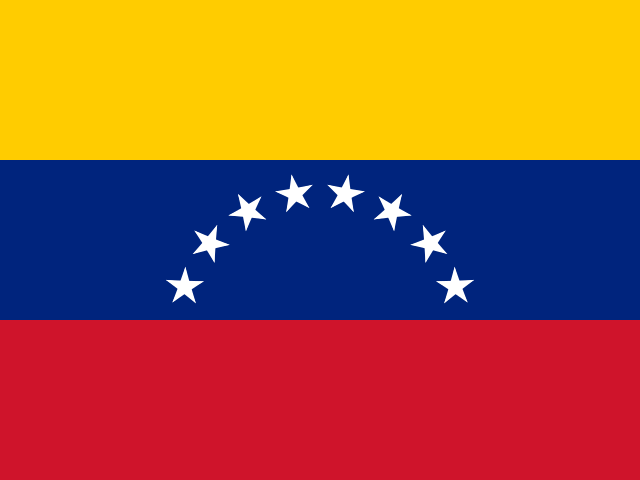 Venezuela